
Undoing borders
“Imperialism is an old sin with the same old consequences.” - Camonghne Felix

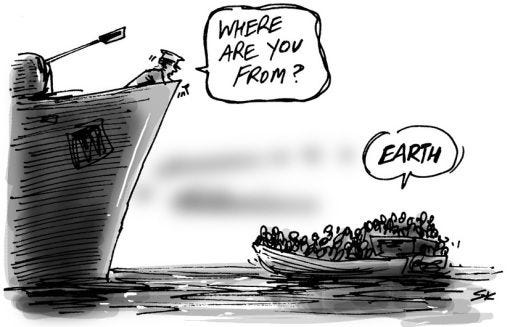
By Simon Kneebone
I am sending love and support to the people of Ukraine and refugees worldwide.
It's difficult to resist the narrative that there are good guys and bad guys, us versus them. Especially in times of crisis, we seek simple solutions that fit into binaries and boxes so we can easily make sense of the chaos. But when we do that, we erase lived experiences, context, nuance, and history that is with us in the present moment. It’s in moments of crisis that we have to hang on to our values the most. As I write this, I'm watching coverage of the war in Ukraine behind the safety of my TV and behind the safety of my U.S. citizenship. I hope to share with you some insight I've gained on the subject of imperialism, colonialism, and their manifestations of social hierarchy.
I want to be clear: the war in Ukraine is an absolute tragedy. I support the Ukrainian people, sovereignty, and their defense efforts. Separate from that, I am experiencing a type of cognitive dissonance when I hear particular critiques of Russia and the coverage of the Ukrainian refugees. Some of the media I've consumed is painting a simplistic picture of the U.S. and the West as heroes of the world…as if it is definitive. Repulicans on Fox News are in support of Putin…which is atrocious. There is an air of arrogance that the West and U.S. could never do such a thing as carrying out a violent occupation…as if European colonialism didn't set the stage for the world today and the U.S. doesn't carry out global military operations consistently. I’m not comparing the U.S. and Russia as means to tally who is “the bad guy” but I'm thinking about how we can hold ourselves accountable for the violence and pain we inflict on humanity. This newsletter criticizes power that fuels social hierarchies and further drives the normalization of harm and violence.
It's unsettling to hear the media (rightfully) condemn Russia's human rights violations but not consider how U.S. violations are horrendous too.
Human Rights Watch lists several human rights issues in the U.S., including the criminal legal system, the healthcare system, racial injustice, and poverty. We act like the U.S. itself isn't a settler colonial state that committed genocide against Indigenous people.
Endless support for Israel's occupation of Palestine, with both financial and military aid. The U.S. has used its UN Security Council veto 53 times to block resolutions against Israel even though they are committing apartheid against Palestine (according to human rights organizations like Amnesty International).
We advocate for democracy, but in 2021, 440 voter suppression bills were introduced in 49 states.
Texas Governor Greg Abbott calls on Texans to report parents of transgender kids for child abuse, even though affirming transgender and non-binary kids' identity significantly reduces suicide rates. Florida's slew of bills, led by Governor Ron DeSantis and majority-white Republican parents, prohibit the teaching of racism, sexism, and gender, which is literally a pillar of fascism.
ICE is a whole militarized police system that criminalizes and abuses undocumented people for crossing an imaginary border. Our government chooses to make the border a place of violence and sexual assault.
On top of everything else, it is jarring to see the beautiful outpour of support for Ukrainian refugees compared to the lack of support for non-European refugees and Black and brown refugees in similar times of crisis. This isn't to say there shouldn't be support for Ukrainians – of course, there should be, as there should be for all people fleeing war and violence. Refugees from Africa, the Caribbean, the Middle East, South Asia, and South America have been branded terrorists, gang members, and economic burdens. This reality is a legacy of colonialism.
Dozens of European and American journalists have made biased references that are deeply problematic, racist, and offensive. As explicitly stated by members of the press, their disbelief for this invasion stems from the fact that it is in Europe, a "civilized" society…unlike the "uncivilized" countries we're so used to seeing at war. The Arab and Middle Eastern Journalists Association put out a statement that succinctly identifies the issue,
"AMEJA condemns and categorically rejects orientalist and racist implications that any population or country is 'uncivilized' or bears economic factors that make it worthy of conflict. This type of commentary reflects the pervasive mentality in Western journalism of normalizing tragedy in parts of the world such as the Middle East, Africa, South Asia, and Latin America. It dehumanizes and renders their experience with war as somehow normal and expected." Full statement here.
The idea of civilized vs. uncivilized was the same mindset that fueled colonialism and led Europeans, men, white people, and the wealthy to consider themselves superior and more human than "the other," justifying genocide, violence, and war. According to No One Is Illegal activist and organizer Harsha Walia, this is the same mindset that drives the war on terror, the war on drugs, and the war on illegals.
I just read Walia’s book, Undoing Border Imperialism, for my abolition geography course. Walia provides a framework for readers to look at how the effects of capitalism, neoliberalism, imperialism, and colonialism continue to create the cycles of displacement, poverty, and forced migration that we see today. She presents the idea that the West isn't only a geographical site but also an ideology. It exists in the military occupations worldwide, destabilizing neoliberal economic policies carried out by the IMF and the World Bank, and the dominance of Western political, social, and economic foundations.
By pointing to the causes of displacement and not the displaced people, she undermines the legitimacy of the border crisis narrative. Quoting geographers Van Houtum, Kramsch, and Zierhofer, Walia writes that borders are "not so much an object or a material artifact as a belief, an imagination that creates and shapes a world, a social reality." Borders aren't a fixed structure but rather an imagination about who belongs and who does not. They separate us from each other by entrenching fear and control against people who are displaced by the violence of world powers. It's what is happening in Ukraine, Palestine, and the U.S. southern border.
A Ukrainian citizen shared a photo and tweeted, "PROOF that you really do get FREE TRAINS if you're a Ukrainian who's escaped into Poland. Showed my passport to the inspector, he printed out the ticket for me, which lists PLN 0.00 on it as a price" This is great and at the same time, I am concerned for people in Ukraine who aren't Ukrainian citizens or who don't have paperwork. Many African people in Ukraine, majorly Nigerian students, are facing brutal racism and have been denied from crossing borders into Poland. It has to be said that safety and freedom of movement to safety shouldn't be withheld because of skin color and/or citizenship, whether in times of “war” or not.
Ultimately disrupting the daily normalization of harm requires a collective connection between us, regardless of nationality, skin color, or any other difference. Walia shares this wisdom on page 62 of Undoing Border Imperialism,
"Gungalidda elder Wadjularbinna, who articulates a similar global vision of undoing border imperialism through collective solidarities and responsibilities to each other rather than to the state or systems of power: 'Before Europeans came here illegally, in the Aboriginal world we were all different, speaking different languages, but we all had the same kinship system for all human beings, in a spiritual way. Our religion and cultural beliefs teaches us that everyone is a part of us and we should care about them. We can't separate ourselves from other human beings—it's a duty.' (98)"
I hope the insights provided here helped create a bit of nuance in the world of geopolitics.
Be well,
Adriana <3